The 12th-Century Intellectual Zeitgeist
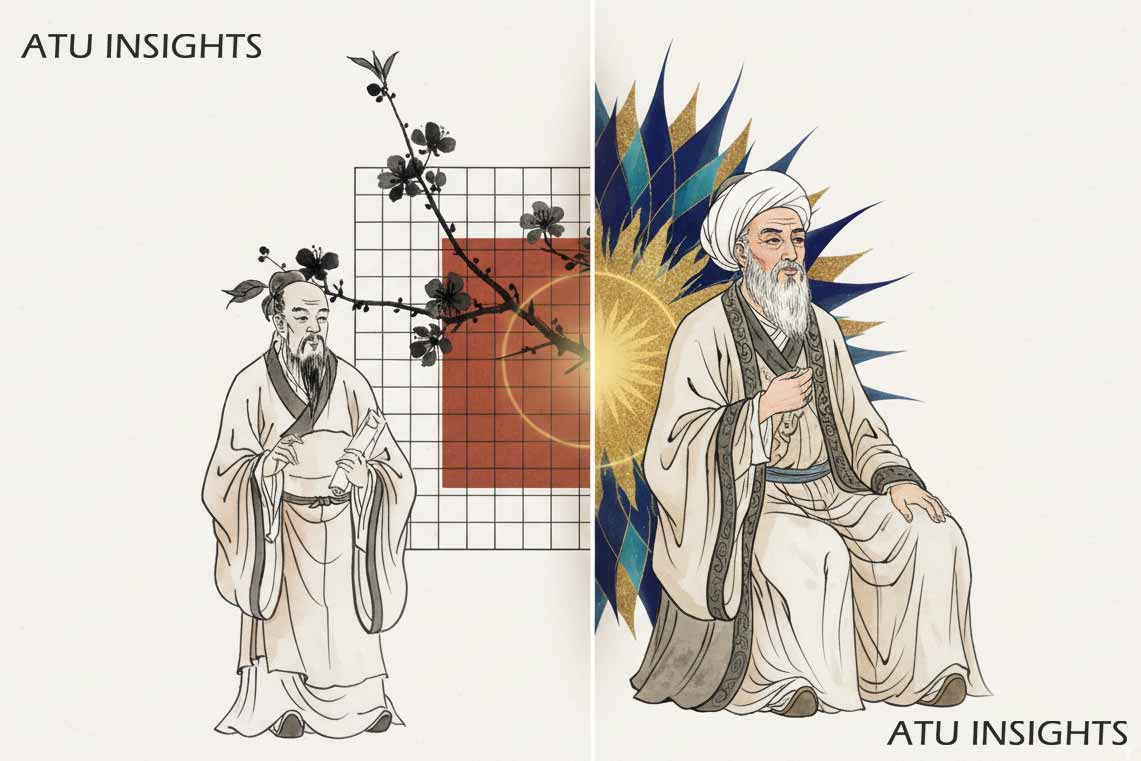
The twelfth century stands as a remarkable epoch in the history of global thought, marked by a simultaneous flourishing of philosophy in both Eastern and Western Asia. While geographically distant, the Song Dynasty in China and the Islamic Golden Age in Persia produced intellectual currents that mirrored one another in their ambition and depth. During this era, two “system builders” emerged who would define the spiritual and intellectual landscapes of their respective civilizations for centuries to come: Zhu Xi (1130–1200 CE) and Shihab al-Din Suhrawardi (1154–1191 CE) (Ahmadvand, n.d., p. 1).
Although these two masters likely never knew of one another, a comparative analysis reveals a fascinating convergence of mission. Both sought to revitalize ancient traditions in response to the philosophical crises of their times. Zhu Xi, often called the “Great Synthesizer” (Li & Xiang, 2020, pp. 15-46), of Neo-Confucianism, sought to reconstruct ethical order through the School of Principle (Dao Xue). Simultaneously, Suhrawardi, the “Master of Illumination” (Shaykh al-Ishraq) (Marcotte, 2016, Chap. 1), worked to harmonize Aristotelian logic with Islamic mysticism and ancient Persian wisdom. While their cultural foundations differed, their ultimate quest was identical: to explain the nature of reality, the path to true knowledge, and the purpose of human existence.
Zhu Xi: The Architecture of Rational Order
Zhu Xi’s philosophy is anchored in a worldview where the cosmos is intelligible, moral, and orderly. His system relies on the interplay of two fundamental concepts: Li (Principle) and Qi (Material Force).
For Zhu Xi, Li represents the unchanging, eternal, and rational patterns that define the essence of all things. It is the moral law inherent in the universe. However, Li cannot manifest without Qi, the vital energy or material substance that gives things their physical form. A common metaphor in this tradition compares Li to the moon and Qi to water; just as the moon is reflected in thousands of rivers and lakes, the singular, universal Principle is present in every individual entity (Patt-Shamir, 2020, pp. 243-263).
This ontological framework dictates Zhu Xi’s epistemology. If moral principle is embedded in the fabric of reality, then the path to knowledge is the “investigation of things” (gewu). This concept, drawn from the Great Learning, suggests that by observing the world, studying classical texts, and reflecting on human relationships, one can apprehend the Li within them. This is not merely an intellectual exercise but a moral one (Ahmadvand, n.d., p. 5). The ultimate goal of human existence in Zhu Xi’s view is “Sagehood” (Angle, 1998, pp. 281-304). A Sage is one who has purified their Qi—clearing away selfish desires—to allow their inherent good nature (Li) to shine forth, thereby achieving harmony with the family, society, and the cosmos.
Suhrawardi: The Hierarchy of Illumination
In stark contrast to Zhu Xi’s rational immanence, Suhrawardi constructed a philosophy of transcendence based on the metaphysics of Light (Nur). Moving away from the peripatetic focus on existence and essence, Suhrawardi proposed that the fundamental reality of the universe is Light in varying degrees of intensity.
At the summit of this hierarchy stands the “Light of Lights” (Nur al-Anwar), the self-subsisting source of all existence. All other beings are emanations from this source, descending in gradations of purity. The material world is not defined by Qi, but by “darkness” or the absence of light (Aminrazavi, 2014, pp. 31-33). In this worldview, reality is not a dualism of principle and matter, but a vertical spectrum of illumination.
Consequently, Suhrawardi’s approach to knowledge differs radically from the Confucian model. While he respected logic, he argued that ultimate truth cannot be accessed through discursive reasoning alone. Instead, he advocated for dhawq (tasting) or mystical intuition. True philosophy, or “Illuminationist wisdom” (Hikmat al-Ishraq), requires the purification of the soul and the use of the “imaginal world” (alam al-mithal) to achieve a direct visionary experience. The goal of human life is not social sagehood, but spiritual “return”—the ascent of the soul back toward the Light of Lights, shedding the veils of the material world to achieve union with the Divine (Sonn, 2015, p. 58).
The Revival of Ancient Wisdom
A defining characteristic of Suhrawardi’s legacy, which parallels Zhu Xi’s revival of Confucianism, was his integration of the “Khosrovani” wisdom of ancient Iran into the Islamic philosophical framework. Suhrawardi viewed the history of wisdom as a “Perennial Philosophy,” tracing a lineage of light that included Hermes, Plato, and the ancient Zoroastrian sages
He adapted four key principles of ancient Iranian thought into his system. First, he incorporated the archetype of the “Perfect Human,” mirroring the Iranian theory of the lordship of species (Arbab Anvaee Irani) (Meisami, 2023, pp. 371-388). Second, he utilized the ancient dualism of Light and Darkness (Good and Evil) not as two gods, but as a method to categorize the gradations of reality (Asadi et al., 2024, pp. 1-26). Third, he echoed the Iranian reverence for the sun (Mithraism) by using it as the supreme symbol of the Divine Intellect in the physical world (Ostovar & Atighechi, 2024, pp. 117-141). Finally, his political philosophy reflected the ancient Persian concept of kingship, where the just ruler is seen as the shadow of God on earth, a manifestation of cosmic order—a concept that deeply influenced Islamic political thought (Frye, 1964, pp. 36-54).
Unity in Diversity
When viewing Zhu Xi and Suhrawardi side by side, we witness a dialectic between rationalism and mysticism that transcends cultural boundaries.
Zhu Xi offers a horizontal, immanent spirituality. He finds the divine in the structure of society and the moral obligations of daily life. His Sage is a pillar of the community, grounding the “Supreme Ultimate” (Taiji) in human interaction. Suhrawardi, conversely, offers a vertical, transcendent spirituality. His path leads upward, away from the shadows of materiality toward the blinding radiance of the Light of Lights.
Yet, despite these divergent paths—one discursive and societal, the other intuitive and visionary—both philosophers highlight a universal human impulse: the desire to find unity within multiplicity. Whether through the rational investigation of Li or the mystical experience of Ishraq, both thinkers affirm that the universe is not chaotic, but meaningful, and that human beings possess the unique capacity to align themselves with that higher order. In an increasingly fragmented world, the synthesizing visions of these 12th-century masters remain vital invitations to integrate the ethical, the rational, and the spiritual dimensions of our lives.
Author: Shoja Ahmadvand – Faculty Member, Department of Political Science, Faculty of Law and Political Sciences, Allameh Tabataba’i University, Tehran, Iran